

A strategic Agentforce Implementation Partners Guide for Salesforce Enterprise Leaders
Salesforce Agentforce represents one of the most significant shifts in enterprise technology in a generation. Unlike traditional CRM tools or point-in-time automation, Agentforce enables autonomous AI agents that can reason, act, and collaborate across your entire Salesforce ecosystem, from Sales Cloud to Service Cloud, Marketing Cloud, and beyond.
But technology alone doesn’t deliver transformation. The organizations that successfully implement Agentforce are those that pair the platform’s power with a clear strategy, strong cross-functional alignment, clean data foundations, and a governance model that keeps AI working for, not against, their business objectives. The best agentforce implementation partners know this and can provide the blueprint for long-term success.
Advanced Cloud Solutions is a certified Salesforce partner
As a certified Salesforce partner with deep expertise in AI-driven transformations, Advanced Cloud Solutions has guided enterprises through every phase of Agentforce adoption. Whether you’re evaluating the platform for the first time or ready to scale existing deployments, our team delivers the strategic advisory, technical implementation, and change management capabilities to ensure your investment drives measurable results.
How to Implement Agentforce In Salesforce the Right Way
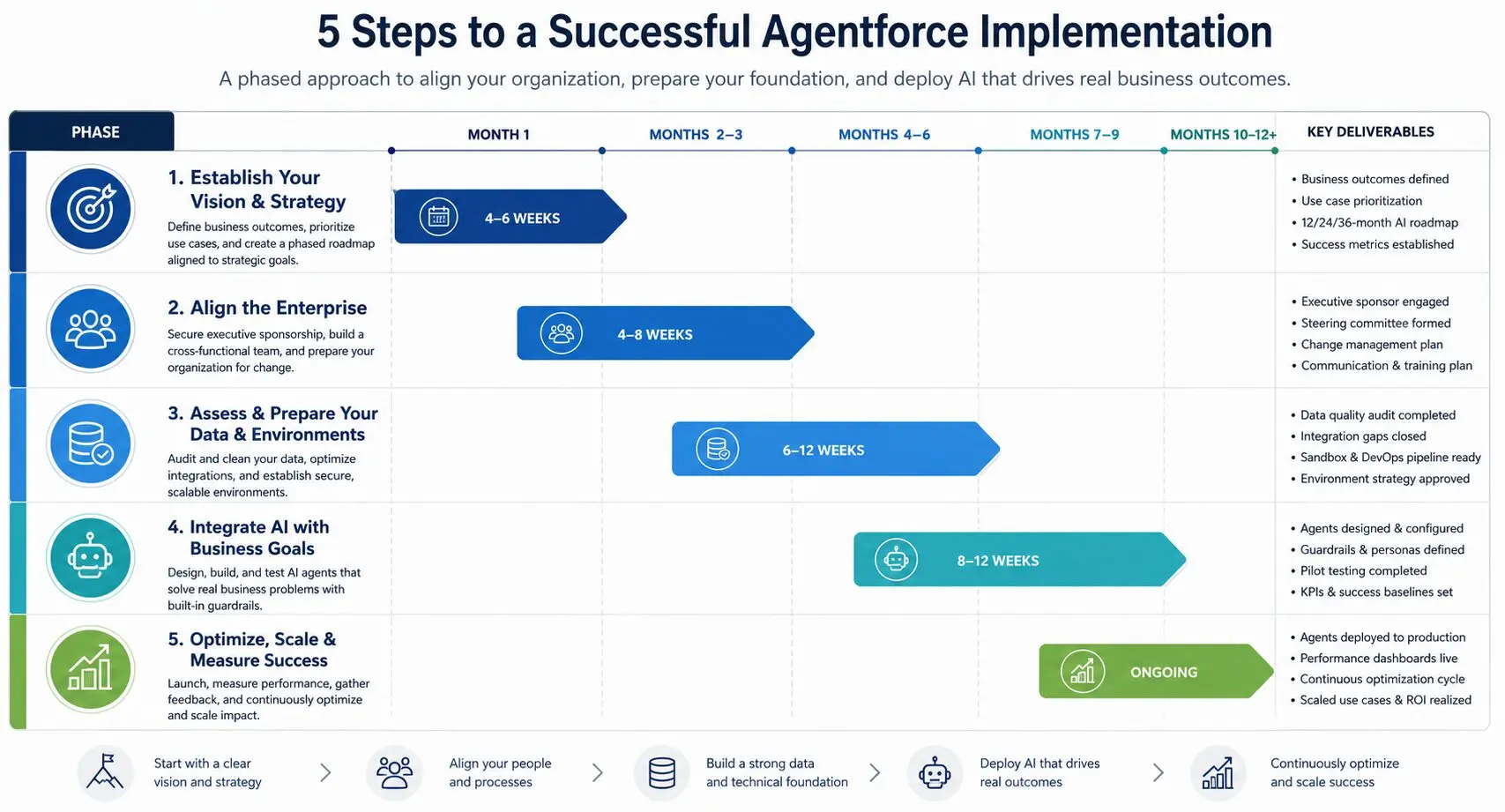
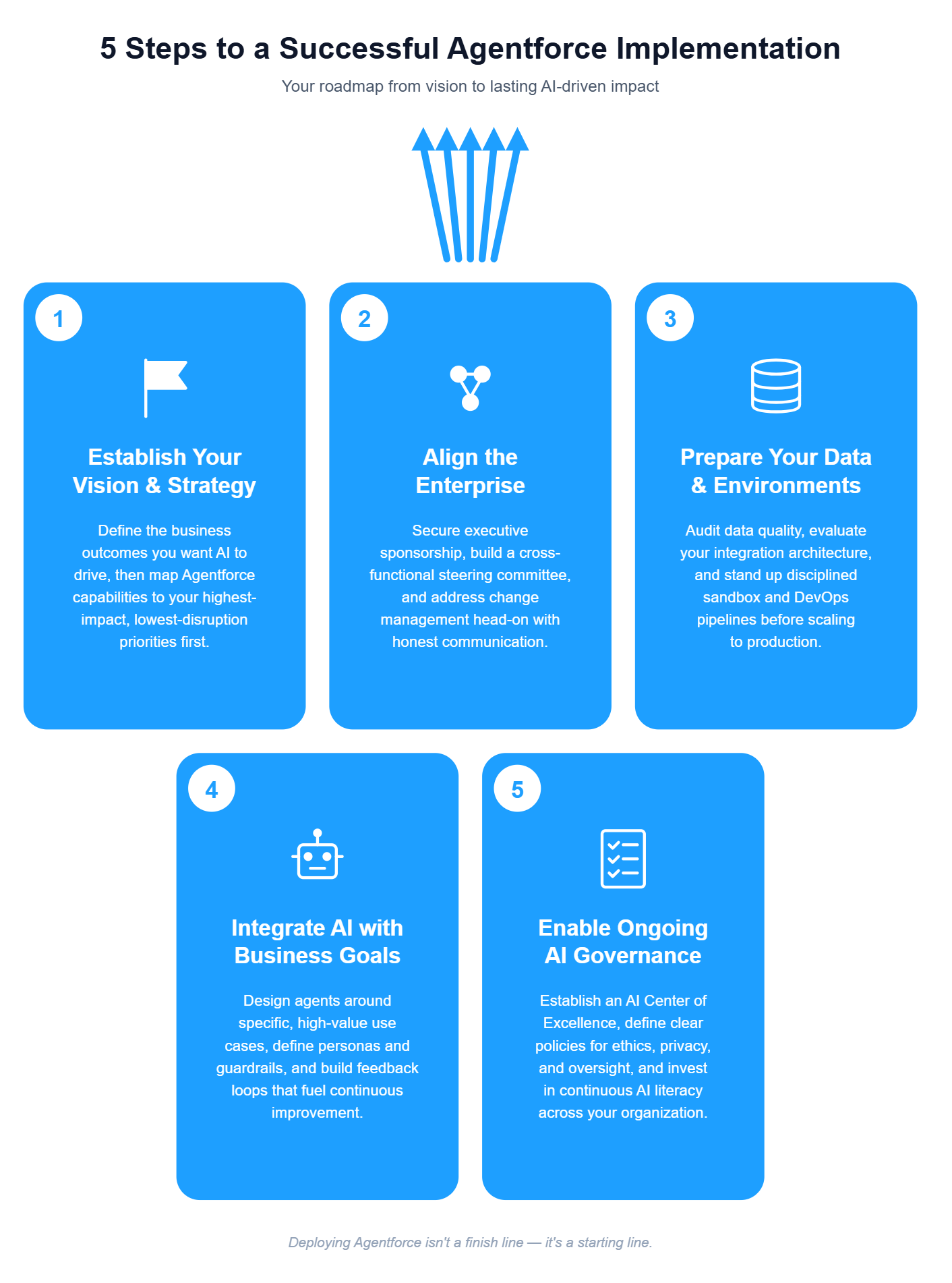
Our five-step Agentforce implementation guide is the proven approach to Salesforce success.
Research consistently shows that AI initiatives fail not because of the technology, but because of poor planning, misaligned stakeholders, and inadequate governance. This framework addresses the full lifecycle, from vision to ongoing operations, so your Agentforce deployment delivers value from day one and continues to grow over time.
- Establish Your Vision & Strategy
Every successful Agentforce implementation begins with a clear answer to one fundamental question: Why are we doing this, and what does success look like? Without a compelling vision and a grounded strategy, even the best-configured Agentforce deployment will drift, producing activity without outcomes.
Define the Business Outcomes You Want to Drive
Start by identifying the specific business challenges you want AI to address. Are you aiming to reduce service resolution times? Accelerate sales pipeline velocity? Improve marketing personalization at scale? The more specific your outcome targets, the more focused and measurable your Agentforce configuration will be.
Key questions to answer at this stage include:
- What processes are most costly, time-consuming, or error-prone today?
- Where could AI agents augment, or fully automate, human decision-making?
- What does a 12-month, 24-month, and 36-month vision for AI capability look like?
- How will success be measured: cost savings, conversion rates, CSAT scores, agent efficiency?
Map AI Capabilities to Strategic Priorities
Agentforce offers a broad suite of AI capabilities, autonomous agents, predictive analytics, generative responses, and workflow automation. A strong strategy prioritizes which capabilities to activate first based on the highest-impact, lowest-disruption opportunities. A phased approach reduces organizational risk and accelerates time-to-value.
- Align the Enterprise
Agentforce isn’t a departmental tool; it’s an enterprise platform. And that means its success depends on something far harder than technology: getting people aligned. In our experience, the most common reason Agentforce projects stall or underdeliver is not a technical failure. It’s an organizational one.
Secure Executive Sponsorship
A credible executive sponsor, ideally at the C-suite or VP level, is non-negotiable. This person champions the initiative, removes organizational barriers, allocates resources, and sends the message that AI adoption is a strategic priority, not a side project. Identify your sponsor early and engage them actively throughout planning.
Build a Cross-Functional Steering Committee
Agentforce touches multiple teams: Sales, Service, Marketing, IT, Legal, HR, and Finance may all be stakeholders depending on the scope. A steering committee with representation from each affected business unit ensures that implementation decisions reflect real operational needs, and that resistance is surfaced early rather than ambushed at launch.
Address Change Management Head-On
People fear what they don’t understand. When employees hear “AI agents,” many instinctively worry about job displacement. A proactive, honest communication strategy is essential. Clarify how AI will augment — not replace — human roles. Establish forums for feedback. Celebrate early wins publicly. Change management is not a soft add-on; it’s a core implementation workstream.
- Develop a communication plan before go-live
- Train team leads and managers to be internal ambassadors
- Create feedback channels so concerns are heard and addressed
- Tie performance metrics to team-level outcomes, not just system usage
- Assess & Prepare Your Data & Environments
AI is only as smart as the data it works with. Before deploying Agentforce agents at scale, organizations must take an honest inventory of their data quality, architecture, and integration landscape. Skipping this step is one of the fastest paths to an AI implementation that falls short of expectations.
Conduct a Data Quality Audit
Salesforce environments accumulate technical debt over time — duplicate records, incomplete fields, inconsistent naming conventions, and stale data. Agentforce agents trained on or operating against poor-quality data will produce poor-quality outputs. A thorough data audit identifies:
- Duplicate or conflicting records across objects
- Missing or incomplete data on critical fields (contact info, account hierarchies, opportunity stages)
- Inconsistent data entry standards across teams or regions
- Legacy integrations are pushing malformed data into Salesforce
Evaluate Your Integration Architecture
Agentforce’s power multiplies when it can connect to systems beyond the Salesforce core — ERP systems, marketing platforms, customer data platforms, service ticketing tools, and more. Assess your current integration architecture and identify gaps where data flows are missing, manual, or unreliable.
Prepare Your Sandbox & DevOps Pipeline
A disciplined environment management strategy, with separate development, testing, UAT, and production orgs, is essential for Agentforce deployments. Establish clear deployment pipelines, version control practices, and rollback procedures before the first agent goes to production.
- Integrate AI with Business Goals
Vision and clean data are prerequisites, but it’s here that Agentforce comes to life. Step four is about designing, building, and deploying AI agents that are explicitly wired to the business outcomes you defined in Step 1. This is not about deploying every available feature; it’s about deploying the right capabilities to the right workflows with the right guardrails.
Design Agents Around Use Cases, Not Features
The most effective Agentforce implementations start with a specific, high-value use case — a service agent that handles Tier 1 support queries, a sales assistant that drafts follow-up emails and updates CRM records, a marketing agent that personalizes outbound sequences based on prospect behavior. Each agent is scoped, tested, and measured before expanding scope.
Establish Agent Personas and Behavioral Guidelines
Agentforce agents interact with customers and internal users on your behalf. Defining agent personas — including tone of voice, escalation thresholds, topics to avoid, and fallback behaviors — ensures consistency, professionalism, and safety across every interaction.
Build Feedback Loops into Every Workflow
AI agents improve through feedback. Design workflows that capture agent performance data: resolution rates, escalation patterns, user satisfaction scores, and conversion metrics. This data fuels continuous improvement and justifies further investment.
- Define KPIs for each agent use case before launch
- Instrument agent interactions for performance monitoring
- Establish review cycles to refine agent prompts, flows, and decision logic
- Align agent KPIs to business metrics stakeholders already care about
- Enable Your Organization with AI Governance
Deploying AI agents is not a finish line; it’s a starting line. The organizations that extract the greatest long-term value from Agentforce are those that treat AI governance as a permanent capability, not a one-time project. Governance ensures your AI operates ethically, compliantly, and in alignment with evolving business needs.
Establish an AI Center of Excellence
An AI Center of Excellence (CoE) is the internal team or function responsible for overseeing AI strategy, standards, and operations. The CoE sets the policies that govern agent behavior, manages the AI roadmap, reviews new use cases, and acts as the internal authority on responsible AI use. Without a CoE, Agentforce deployments tend to proliferate unevenly — with inconsistent quality and mounting technical debt.
Define and Enforce AI Policies
AI governance policies should address:
- Data privacy and residency requirements (GDPR, CCPA, HIPAA, and others)
- Acceptable use boundaries for AI-generated content
- Human-in-the-loop requirements for high-stakes decisions (contracts, pricing, sensitive customer interactions)
- Bias monitoring and fairness review processes
- Model and prompt version control and change management
Invest in Ongoing Training and Enablement
AI literacy across the organization is a competitive advantage. Equip your teams — from frontline users to executive stakeholders — with the knowledge to understand what agents can do, how to work alongside them effectively, and how to flag issues when they arise. Continuous training is not optional; it’s how adoption deepens over time.
Plan for Evolution
The Salesforce AI roadmap moves fast. New Agentforce capabilities, Einstein features, and Data Cloud integrations are released quarterly. A strong governance model includes a process for evaluating and adopting new capabilities in a controlled, business-aligned way — so you stay ahead of the curve without introducing unnecessary risk.
Your Trusted Agentforce Implementation Partner
Advanced Cloud Solutions is a certified Salesforce partner specializing in enterprise AI transformation. We combine deep Salesforce platform expertise with proven change management capabilities and a track record of delivering measurable outcomes for clients across financial services, healthcare, manufacturing, retail, and professional services.
We don’t just implement, we partner. From initial strategy through long-term governance, we’re with you at every step.
Our Differentiators
- Business-First Approach: Every technical decision is grounded in a business outcome. We measure success the same way you do.
- Proven Methodology: Our five-step framework has guided successful Agentforce deployments across enterprise clients in multiple industries.
Contact us today to schedule your complimentary Agentforce Readiness Assessment and discover exactly where your organization stands, and how quickly you could be generating real AI-driven value.