

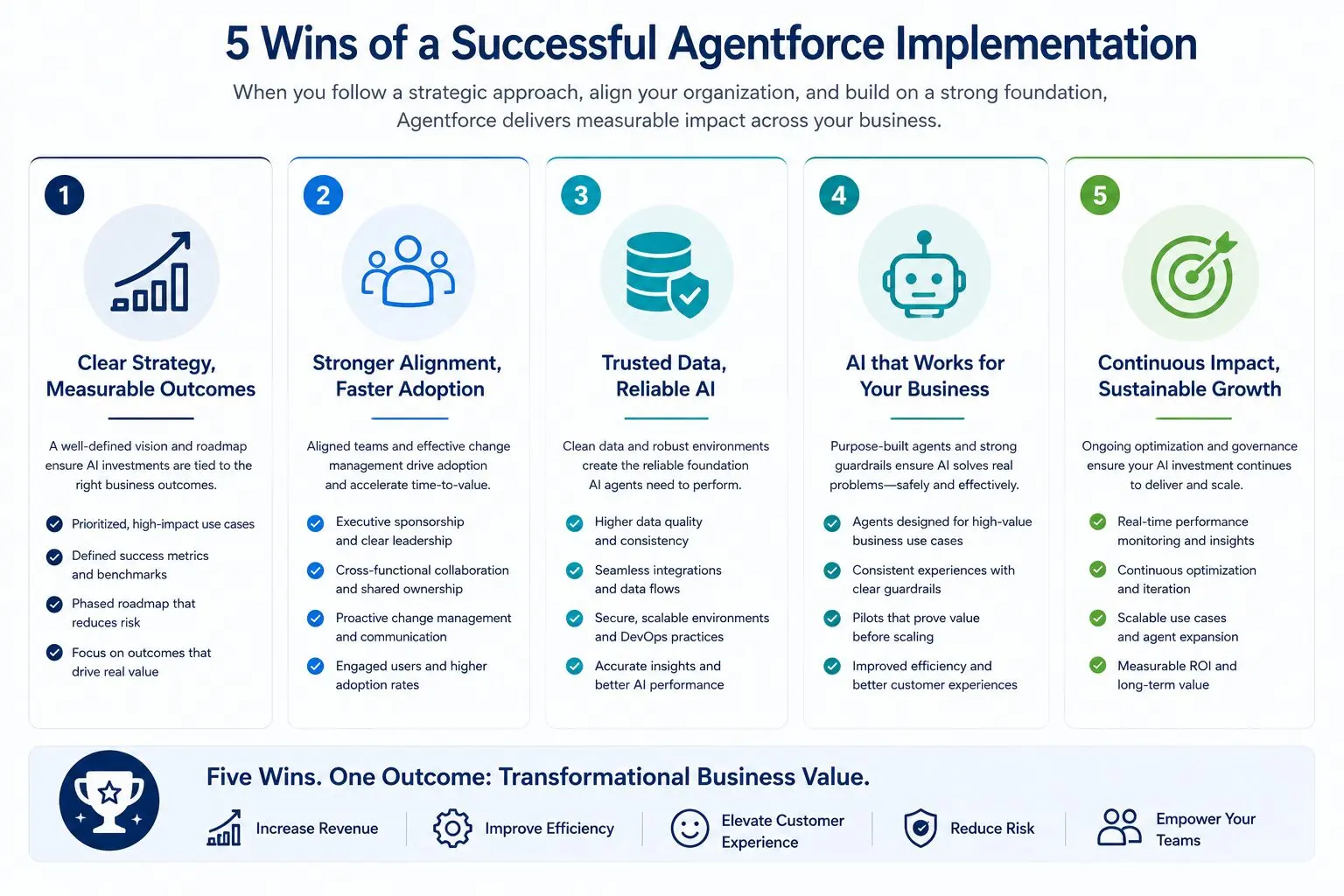
A practical Agentforce guide to fostering trust, adoption, and lasting impact with AI agents
Agentforce represents a powerful shift in how businesses operate, but technology alone doesn’t drive transformation. People do. The real challenge isn’t deploying AI agents; it’s getting your teams to trust them, use them, and champion them. Confidence in Agentforce is built deliberately, not by accident.
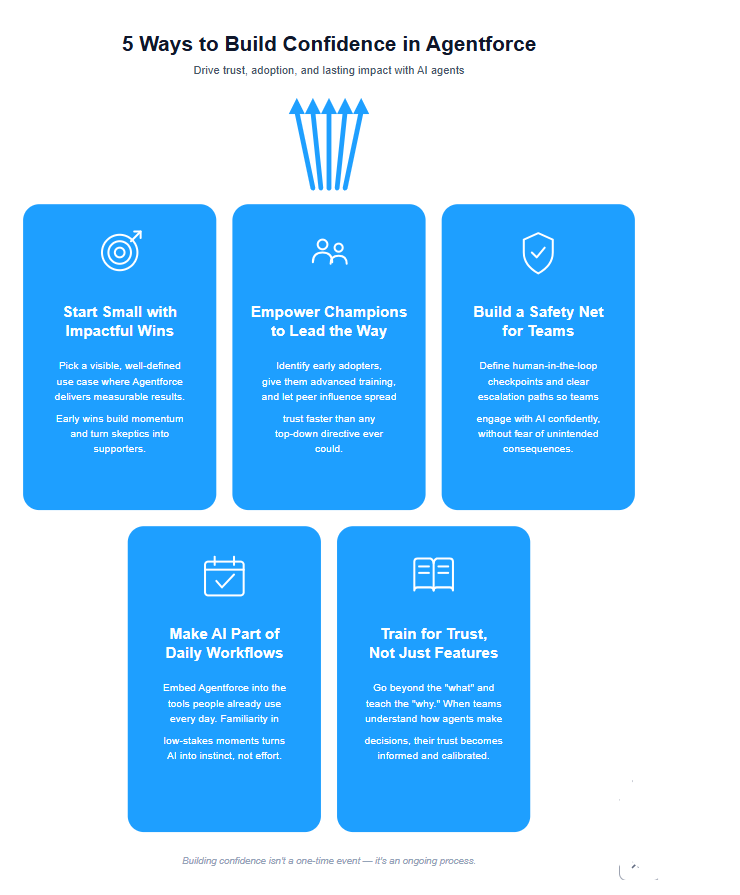
Here are five proven ways to build that confidence from the first Salesforce deployment to organization-wide adoption.
1. Start Small with Impactful Wins
One of the most effective ways to build confidence in any new technology is to demonstrate real, tangible results early. Rather than attempting a sweeping enterprise rollout, identify a single, well-defined use case where Agentforce can deliver clear value and start there.
Think about a repetitive, time-consuming task that frustrates your team or slows your service delivery. Maybe it’s handling common customer inquiries, routing support tickets, or generating routine reports. These are ideal starting points because the baseline is visible and the improvement is measurable.
When your team sees an AI agent successfully resolving 200 support tickets in the time it used to take to resolve 50, the abstract concept of “AI” becomes a concrete business tool. That first win creates momentum. It gives skeptics something to observe, gives leaders something to celebrate, and gives your organization the confidence to take the next step.
Key principle: Choose your first use case for impact and visibility, not just technical simplicity. A win that people notice is worth far more than one that goes unseen.
2. Empower Champions to Lead the Way
Technology adoption lives or dies on peer influence. When employees see a respected colleague using Agentforce effectively and talking about it positively, trust spreads far faster than any top-down directive could achieve.
Identify the early adopters and enthusiasts in your organization. These are the people who ask curious questions about new tools, volunteer for pilot programs, and naturally influence their peers. Invest in them. Give them early access, advanced training, and a platform to share their experiences.
Champions do something that documentation and leadership messaging cannot: they make the technology feel accessible. A colleague who says, “I was nervous about this too, but here’s what changed for me,” is far more persuasive than a polished presentation from an executive.
Key principle: Don’t just train users — cultivate advocates. Champions amplify trust across the entire organization while providing ground-level feedback that improves your rollout.
3. Build a Safety Net for Teams
Fear of making mistakes is one of the biggest barriers to AI adoption. If employees worry that a wrong interaction with an AI agent could damage a customer relationship, expose sensitive data, or create compliance issues, they’ll avoid the tool entirely.
Building confidence requires building guardrails. This means implementing clear human-in-the-loop checkpoints for high-stakes decisions, defining escalation paths so agents hand off to humans when uncertainty is detected, and communicating those safeguards transparently to your teams.
It also means creating a culture where questions are welcomed and errors are treated as learning opportunities rather than failures. When teams know there’s a net beneath them, that the system has been designed thoughtfully, and that mistakes won’t be catastrophic, they engage more openly and learn more quickly.
Key principle: Confidence isn’t recklessness — it’s informed trust. Give teams the structure and support they need to engage with Agentforce without fear of unintended consequences.
4. Make AI Part of Daily Workflows
Confidence grows through familiarity. When Agentforce is embedded into the tools and processes employees already use every day, rather than positioned as a separate system, they must remember to consult; it becomes a natural part of how work gets done.
Work with your teams to identify the moments in their daily workflow where an AI agent could add the most value: summarizing meeting notes, drafting follow-up emails, pulling CRM data before a client call, or flagging at-risk accounts. Then integrate Agentforce directly into those touchpoints.
The more frequently employees interact with the technology in low-stakes, familiar contexts, the more comfortable they become with its capabilities and limitations. Over time, what once felt unfamiliar becomes instinctive, and that instinct is the foundation of genuine confidence.
Key principle: Integration is adoption. When AI fits seamlessly into how people already work, usage becomes habitual rather than effortful.
5. Train for Trust, Not Just for Features
Most training programs make a critical error: they focus almost entirely on what Agentforce can do and very little on why it works the way it does. The result is employees who can follow a set of steps but don’t understand the system well enough to trust it when something unexpected happens.
Training that builds genuine trust goes deeper. It explains how agents are designed to make decisions, what data they have access to (and what they don’t), how outputs are generated, and the boundaries of their authority. It also covers failure scenarios, what happens when an agent encounters something it wasn’t trained for, and how the system is designed to handle those moments gracefully.
Consider supplementing technical training with scenario-based learning, such as exercises that show employees the AI agent navigating realistic, nuanced situations. The more employees understand the logic behind the system, the more calibrated their trust becomes: neither blind faith nor unfounded skepticism, but informed confidence.
Key principle: Understanding drives trust. When employees know how the system works, they can confidently leverage it, and identify when human judgment should take over.
Build Confidence with Agentforce
Building confidence in Agentforce is not a one-time event; it’s an ongoing process of demonstrating value, supporting people, and deepening understanding. Organizations that approach AI adoption with this mindset don’t just implement a tool; they build a culture of informed, empowered AI use.
Start with a win. Find your champions. Create safety nets. Embed AI in daily work. And train your teams to understand the technology in front of them.
Your team’s confidence in Agentforce shouldn’t be left to chance. Partner with our experts to design a rollout that drives real adoption from day one.